
Philadelphia County Arrest Records and Charges
Philadelphia County arrest records describe the arrest and custody side of an incident: the person, police identifier, booking path, custody location when held by the Philadelphia Department of Prisons, and agency context. Court charge records are different. They show what the prosecutor filed in court after the arrest, including complaint number, OTN, statute, grade, count, offense date, charge status, bail, and court events. The first public court record is often a Municipal Court docket.
The distinction prevents a common error. The custody side is best checked through the Philadelphia Department of Prisons locator and related jail channels when the person may still be in local custody. The court charge side is checked in UJS Case Search and, for later felony cases, Common Pleas dockets. Full pleas, verdicts, dispositions, and sentences belong in the Philadelphia County criminal court records case file, while this page focuses on court charges after arrest.
The Philadelphia Police Department homepage source capture is included because police contact and public-safety notices often begin the public arrest context.
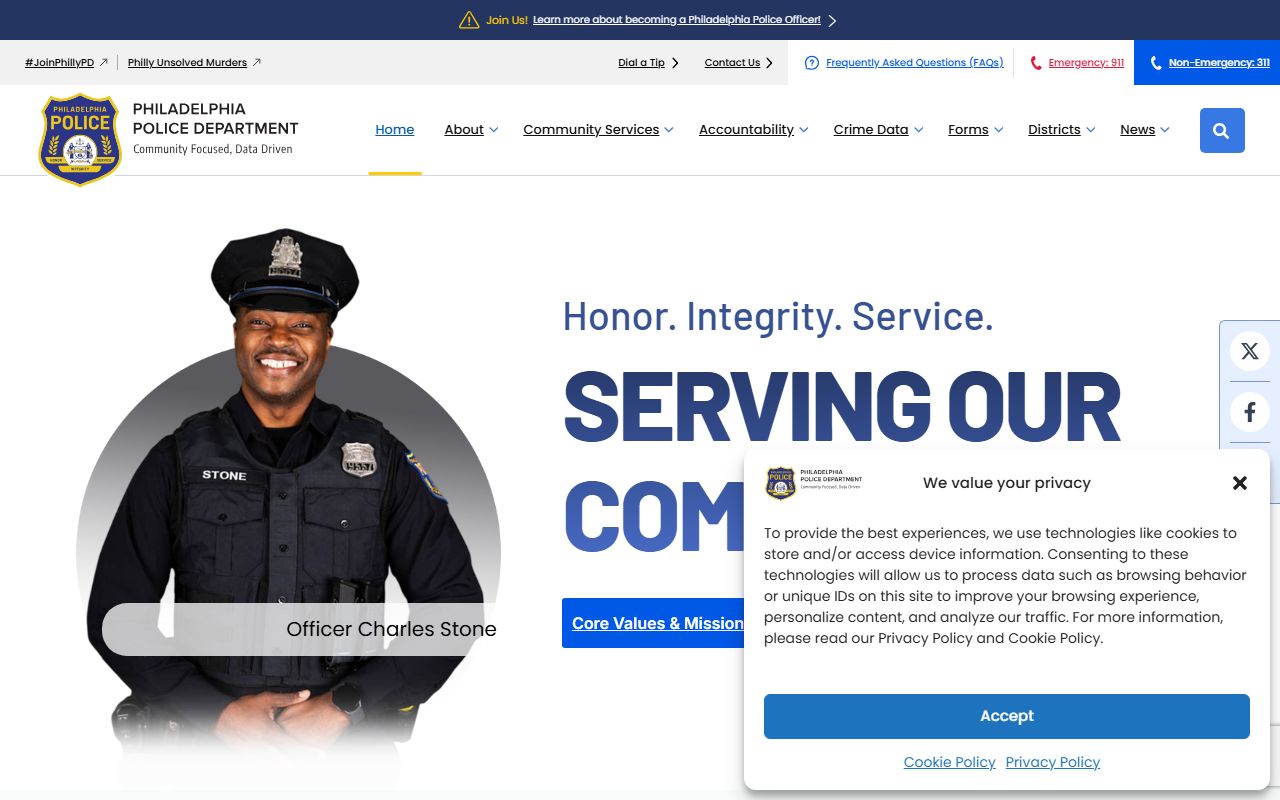
Police information can identify the agency side of an incident, but court charge status must be verified through court records.
Search Philadelphia Arrest Records and Charges
Use the public court path for charges and the custody path for current local jail location. UJS Case Search is the main public route for Municipal Court and Common Pleas criminal docket sheets. Philadelphia Municipal Court processes every criminal arrest, conducts misdemeanor trials, and conducts preliminary hearings for felony cases. If a felony is held for court, the case may continue in Common Pleas under a related CP docket number. The cross-court docket number field is the key connector.
- Search UJS by participant name, docket number, OTN, complaint number, police incident number, or date filed.
- Limit the search to Philadelphia and the correct court type when the portal provides court and county filters.
- Open Municipal Court results first for recent arrests because Philadelphia Municipal Court handles initial criminal processing.
- For felony matters, look for the cross-court docket number and open any linked Common Pleas docket.
- Use the Philadelphia incarcerated-person locator only for custody location, not as a full charge or disposition record.
Philadelphia County Charges After Arrest
Charges after arrest are shown through charging records and docket entries. The research source names complaint number, OTN, statute, grade, count number, offense date, initial court, and charge status as key charge-level fields. Pennsylvania practice often uses a criminal complaint at the start and a prosecutor-filed information in Common Pleas felony cases. The research did not identify a routine Philadelphia public indictment path, so indictment is included only as a general charging-document category and should not be assumed for ordinary Municipal Court starts.
| Document | Filed By | Philadelphia Use | What It Adds to the Record |
|---|---|---|---|
| Complaint | Police or prosecution path | Common start for criminal court processing after arrest | Complaint number, OTN, alleged offense, statute, grade, and initiating court. |
| Information | District Attorney | Common Pleas felony prosecution after preliminary proceedings | Formal prosecutor charge document tied to the CP case. |
| Indictment | Grand jury | Not documented as the routine public path in the Philadelphia research | Formal grand-jury charging document where applicable. |
One arrest can produce more than one count. Each count should be checked for its own statute, grade, status, plea, disposition, and sentence because charges in the same case can end in different ways.
Philadelphia County Charge Status Records
Charge status changes as the case moves. A charge can begin as pending, be amended to a different statute or grade, be reduced as part of a plea, be dismissed at a hearing, be withdrawn, or be nolle prossed by the prosecutor. Philadelphia criminal records can also show held-for-court entries when felony charges move from Municipal Court to Common Pleas. Do not read an original charge as the final outcome.
| Status | What It Means | Why It Matters |
|---|---|---|
| Pending | The charge is active and has not reached a final result. | Later docket entries may change the grade, statute, plea, or result. |
| Held for Court | A felony matter moved from Municipal Court to Common Pleas. | Search the linked CP docket for later case events. |
| Amended or Reduced | The charge changed from the original filing. | The final count may differ from the arrest-era complaint. |
| Dismissed | The court did not allow the charge or case to proceed. | A dismissed charge is not a conviction. |
| Nolle Prosequi | The prosecutor chose not to pursue the charge. | The docket may still show the charge history and its final status. |
| Sentenced | The charge ended in conviction and punishment or conditions were imposed. | Use the full criminal court record for sentence terms. |
Note: In Philadelphia, the MC docket may explain the start while the CP docket explains the felony outcome.
Philadelphia County Charges vs Convictions
A charge is not proof that the person was found guilty. It is the accusation placed before the court. A conviction is a case or count result after a guilty plea, verdict, or other qualifying adjudication. Philadelphia County arrest records may lead to court charges that are later dismissed, withdrawn, nolle prossed, amended, or reduced. That is why a record lookup should read the disposition for every count.
| Point | Charge | Conviction |
|---|---|---|
| Timing | Filed after arrest or case initiation | Entered after plea, verdict, or qualifying adjudication |
| Meaning | Accusation by the Commonwealth | Finding or admission of guilt on a count |
| Can Change | May be amended, reduced, dismissed, or nolle prossed | May be appealed, vacated, sealed, or expunged if eligible |
| Where to Read | Charge rows, complaint data, OTN, MC or CP docket entries | Plea, verdict, disposition, and sentencing fields |
Philadelphia County Charge Code Records
Philadelphia charge records can list statute section, offense description, grade, count number, and offense date. Grade helps show severity, such as felony, misdemeanor, or summary-level treatment where applicable. A single arrest can lead to several counts. Some may be held for court, some may be dismissed, and some may be reduced. The docket should be read count by count, not only by the first charge line.
Key identifiers matter. OTN means offense tracking number. Complaint number links the court case to the initiating criminal complaint. Police incident number can help when a person has several cases or common names. The cross-court docket number is especially important in Philadelphia because it connects Municipal Court processing to Common Pleas felony adjudication.
DA and Defender Roles
The Philadelphia District Attorney manages prosecution. The research identifies the official office site, leadership page, and divisions page, including the Charging Unit and Conviction Integrity Unit. Police arrests and complaints start the process, but the prosecutor decides or manages formal charging. Misdemeanor trials and felony preliminary hearings may remain in Municipal Court, while felony cases that move forward go to Common Pleas.
The Defender Association of Philadelphia is the local public defender entity. The City 311 source lists the Public Defender's Office at 1441 Sansom Street, Philadelphia, PA 19102, phone 215-568-3190, and fax 267-765-6977. The Defender Association homepage describes client-focused legal defense, courtroom advocacy, connections to resources, and reform work.
The Defender Association of Philadelphia source capture is included because defense contact is directly relevant to charges after arrest.

People facing active charges should rely on counsel and official court notices rather than public search results alone.
Philadelphia County Criminal History Limits
Pennsylvania law separates court dockets from criminal-history record information. 18 Pa.C.S. Section 9121 governs dissemination of criminal history record information. UJS public docket sheets are useful for charge and case research, but they are not a full Pennsylvania criminal-history background check. Court dockets can also omit confidential, sealed, expunged, very recent, or restricted material.
For court charge research, start with UJS and the Philadelphia MC/CP link. For a current local custody check, use the PDP locator, which requires either a police identification number or full name with date of birth and covers only Philadelphia Department of Prisons facilities. For state-sentenced people, use the Pennsylvania Department of Corrections locator. For federal custody, use the Bureau of Prisons locator.
Sealed Philadelphia County Charge Records
Restricted charge records include juvenile matters, sealed cases, expunged cases, and records with confidential identifiers or victim/minor information. Pennsylvania's public access policy controls court case record redactions and confidentiality. The key criminal expungement statute is 18 Pa.C.S. Section 9122. Before seeking relief, identify each MC and CP docket number tied to the incident.
| Point | Sealed | Expunged |
|---|---|---|
| Public Access | Restricted from ordinary public view | Removed, destroyed, or segregated after processing |
| Common Result | Docket or case access is limited | Eligible record information is removed under court order |
| Authority | Court order, rule, policy, or Clean Slate limited access | 18 Pa.C.S. Section 9122 and related court order |
| Verification | Check court order and updated official docket access | Use court orders and official repositories, not private search sites |
Bail and Warrant Clues
Charge dockets may show bail type, bail amount, release conditions, bench warrants, capias entries, or other warrant-related events when public. Philadelphia does not publish one complete public active warrant search for all warrant types. The Sheriff's Top Priority List is a priority fugitive and tip tool, not a full warrant database. UJS docket sheets can show public warrant clues tied to a criminal case, especially after missed hearings or noncompliance.
When a docket shows a warrant or failure-to-appear event, do not assume the issue is resolved until the court or counsel confirms it. Public systems may update after court staff enter later orders. For active warrant concerns, use court channels, counsel, or the Philadelphia Sheriff's Warrant Unit information from the warrant records research.